
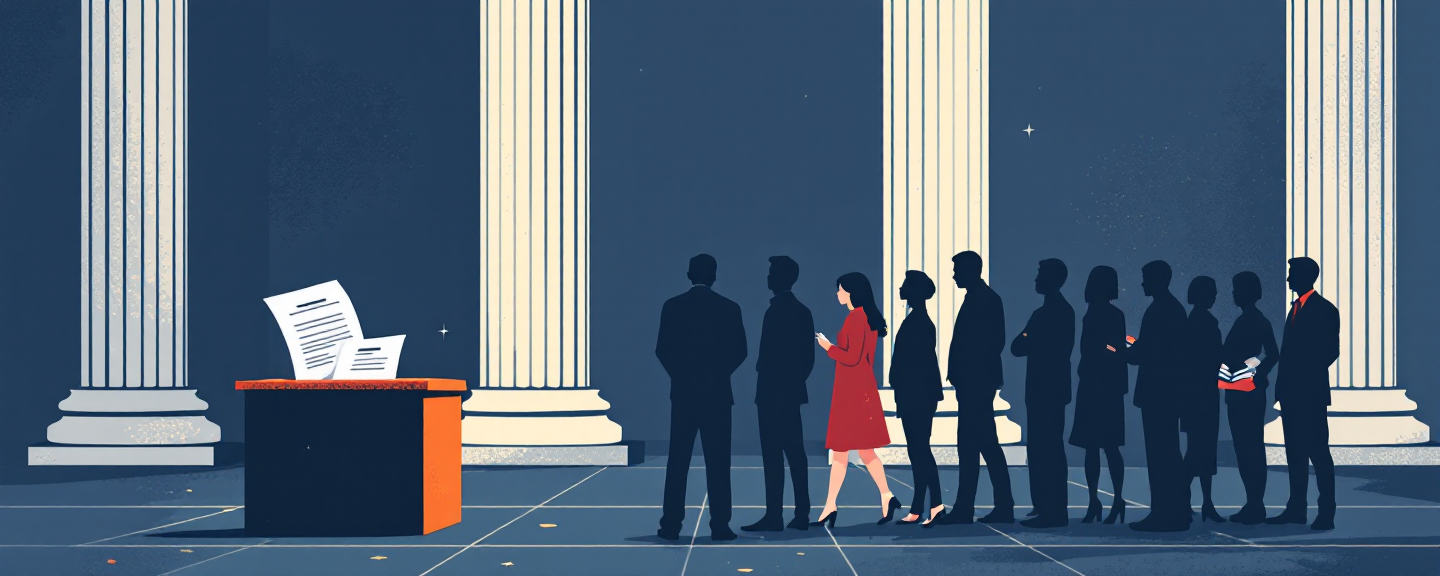
Rules of Engagement: Federal Forces at Polling Sites
This article has been corrected. 1 correction — see Corrections at the end of this article.
Recent Developments (Entry Point for Updates)
This section logs significant developments in reverse chronological order. Election Day is November 3, 2026.
September 4, 2026 — A House member formally demands the written DHS policy that does not exist. Rep. Raja Krishnamoorthi (D-IL), a senior member of the House Oversight and Government Reform Committee, wrote to the Department of Homeland Security asking for three things: a definitive, unqualified statement of Department policy on whether ICE, CBP or any other DHS component will deploy personnel to or within sight of any polling place, ballot drop box or election office during early voting or on Election Day 2026; all guidance, directives and operational plans on the subject, including any concerning Special Response Team deployment; and a precise definition of the “specific threat” standard DHS describes publicly but has never defined — including who inside the Department may decide the standard has been met, and what review occurs before agents are sent. He requested a response by September 10.
September 4, 2026 — Mail-ballot litigation: the operative order changed. Judge Indira Talwani granted a preliminary injunction barring enforcement of the USPS ballot-mail rule for the November 3 election. The Trump administration asked the Supreme Court on September 6–7 to stay that injunction, and that application is pending. The June 25 injunction this document previously described was vacated on August 26 after a Supreme Court stay in a separate case; it is no longer what protects mail voters. See the USPS mail-ballot brief for the full chronology and for the advice that survives either outcome.
September 1, 2026 — Homeland Security Secretary Markwayne Mullin will not rule out ICE at polling places. Speaking to reporters in New York, Mullin said ICE “isn’t there to patrol the polling places,” but added that agents could be present “if there is a threat to that polling place or we’re serving a warrant on someone that we have been actively tracking down,” and that “if we’re serving a warrant we will be where we need to be.”
August 31, 2026 — The Chairman of the Joint Chiefs of Staff rules out the military. Gen. Dan Caine’s August 28 letter to Sen. Elissa Slotkin (D-MI), released by her office, states that the Joint Force “has no plans to send Federal military personnel or Federalized members of the National Guard to polling places during the 2026 elections,” nor to use such personnel “to seize ballots, voting machines, or other election-related material.”
August 26, 2026 — Maine’s Republican nominee for governor says he will ask for federal agents at the polls. Audio from an August 20 event, obtained by the Associated Press and first reported by the Bangor Daily News, has Bobby Charles telling a Maine Young Republicans group he would ask White House border czar Tom Homan to send U.S. Marshals and ICE agents to Maine polling places in the weeks before Election Day.
June 30, 2026 — Congress questions ICE about Syracuse. At a joint hearing of two House Homeland Security subcommittees, Rep. Bennie Thompson (D-MS) questioned a senior ICE official about agents who entered a Syracuse, New York polling place a week earlier. See “What Actually Happened in 2026” below.
June 30, 2026 — Supreme Court strikes down coordinated party spending limits (6–3). In NRSC v. FEC, the Court overruled the 2001 Colorado Republican precedent on First Amendment grounds. Not directly about armed forces at polls — but the elimination of coordinated spending limits means party committees can fund “election integrity” observer operations in direct coordination with candidates, which bears on the volume of organized civilian presence at competitive-district polling places.
June 23, 2026 — Federal agents entered a polling place in Syracuse, New York. The single documented incident of federal agents inside an American polling place during voting in 2026. Detailed below.
The short answer: Bringing “troops or armed men” to any polling place is a federal crime under 18 U.S.C. § 592, punishable by up to two years in prison, and has been since Reconstruction. No federal deployment to polling places has been announced, and the nation’s highest-ranking military officer has said in writing that none is planned. What has not been given is a written Department of Homeland Security policy ruling out an ICE presence — and on June 23, 2026, federal agents walked into a Syracuse polling place during voting in a state that has a law against it. The threat here is real and unresolved. It is not a scheduled event.
The Law: What Federal Forces Cannot Do at Polls
18 U.S.C. § 592 — The Core Prohibition
“Whoever brings to any polling place… any troops or armed men… shall be fined under this title or imprisoned not more than two years, or both.”
This statute dates to Reconstruction — specifically, Congress’s response to the use of federal troops to police elections in the post-Civil War South. The law contains one exception: armed federal forces may be present at a polling place if they are “necessary to repel armed enemies of the United States.” That exception has never been applied to a domestic election.
The statute applies to:
- Active-duty U.S. military personnel
- Federalized National Guard troops (National Guard operating under Title 10 federal authority)
- Armed federal law enforcement acting as a military presence
The statute does not prohibit:
- Unarmed civilian election observers (including Republican “Election Integrity Army” volunteers)
- State law enforcement officers operating under state authority (state law governs this)
- State National Guard troops operating under state authority (Title 32) at the invitation of their governor
Where the protection stops is the part most people get wrong. The federal prohibitions attach at the polling site and, in combination with state electioneering rules, usually within 100 feet of it — sometimes more. Steve Huefner, professor of law and judicial administration at Ohio State’s Moritz College of Law, told States Newsroom in September 2026 that beyond that radius the analysis “gets much trickier.” Agents parked across the street from a precinct are in a legally murkier position than agents inside it, and the intimidating effect on voters walking in does not respect the line. That gap is precisely what the new state buffer laws described below are trying to close — and why most states, which have no such law, are relying on a 100-foot perimeter.
Additional Federal Criminal Statutes
| Statute | Prohibition | Penalty |
|---|---|---|
| 18 U.S.C. § 593 | Federal armed forces members preventing qualified voters from voting | Up to 3 years |
| 18 U.S.C. § 594 | Intimidating, threatening, or coercing any person to vote or not vote in any way they choose | Up to 1 year |
| 18 U.S.C. § 1385 (Posse Comitatus Act) | Using any part of the federal armed forces to “execute the law” without specific congressional authorization | Up to 2 years |
| 52 U.S.C. § 20511 | Election fraud by officials | Up to 5 years |
The Insurrection Act — The Only Legal Pathway for Military at Polls
The Insurrection Act (10 U.S.C. §§ 251–255) creates an exception to the Posse Comitatus Act. If the president invokes the Insurrection Act, federal military forces can be used for domestic law enforcement in a temporary capacity. Even the Insurrection Act does not override 18 U.S.C. § 592 — the Brennan Center has concluded that Congress did not intend the Insurrection Act to authorize stationing troops at polling places in contravention of the post-Civil War prohibition.
Key constraint: The Insurrection Act requires a presidential proclamation and a formal order “to disperse” before troops can be used. It is not a blanket grant of domestic military authority. As of September 7, 2026, it has not been invoked in connection with the November election.
What Actually Happened in 2026
The honest summary is that 2026 produced one documented incident, one written assurance, a set of refusals to commit in writing, and a list of unanswered questions. Those four things are set out below in that order. None of them amounts to an announced deployment, and any document telling you otherwise is ahead of the evidence.
The Syracuse Incident — the one documented breach, and why it matters most
On June 23, 2026 — New York’s primary Election Day — two federal agents entered a polling place at the Syracuse Central Library in Onondaga County and confronted a poll worker.
The worker, Paigelynne Gonyea, was serving as an election inspector. The agents were not there about voting. They came to present her with a form warning her about a January Instagram post in which she named the ICE officer who fatally shot Renee Good in Minneapolis — a name that had already been published by news organizations. DHS later told reporters the post had included the officer’s home address; Gonyea says she can find no such post, and DHS declined a reporter’s request to produce it.
The details matter, because each one shows a different way the protections failed:
- The agents had already tried her apartment. They went to her home first, left a voicemail identifying the caller as a Homeland Security special agent, then came to the polling place while polls were open.
- She let them in — and that is not a legal authorization. Kevin Ryan, the county’s Republican election commissioner, called the episode “a comedy of errors”: Gonyea, as a poll inspector, “should have known not to invite the agents in,” and it was “a mistake” for the agents to enter. Dustin Czarny, the Democratic commissioner, said state election law lets only voters, poll workers, inspectors and voter assistants inside a polling place, and that “there’s no role for law enforcement officials to be inside a polling place unless they are responding to an emergency of some kind. There is no indication of that here.” Both commissioners, of both parties, said the agents should not have been there.
- Whether the agents were armed is unclear — and § 592 turns on exactly that word. A statute that reaches “armed men” does not answer a case where nobody established whether the men were armed.
- New York had a law, and the law did not prevent it. New York restricts immigration authorities from accessing the non-public areas of state-owned or operated facilities, which include polling locations, without a judicial warrant. The National Conference of State Legislatures characterizes New York’s 2026 enactment as permitting sensitive locations, including polling places, to adopt regulations limiting immigration-enforcement presence — not an outright ban of the kind Connecticut, New Mexico, Rhode Island and Virginia passed. Whatever its precise scope, it did not stop two agents from walking in on primary day.
No one was charged. Czarny referred the incident to the state Board of Elections and to the civil rights bureau of New York Attorney General Letitia James’s office, and state prosecutors reviewed it. That is where it ended.
Congress questioned ICE about it on the record. On June 30, 2026, at a joint hearing of two House Homeland Security subcommittees — a hearing the Republican majority had convened about the northern border — Rep. Bennie Thompson (D-MS), the committee’s ranking Democrat, questioned Michael Krol, ICE’s assistant director for domestic operations at Homeland Security Investigations. Thompson also cited reports of ICE vehicles in the parking lots of California polling locations earlier that month. The exchange produced three things worth recording:
- Krol said the visit “had nothing to do with voting or trying to intimidate people at polling places” — the person “was a suspect that the agents from OPR were attempting to interview.” He offered no further detail.
- Asked what training ICE agents receive on the statute barring armed federal officers from polling places, Krol said he did not know. Thompson asked him to get back to the committee with specifics.
- Asked whether ICE would agree not to deploy agents in or near polling locations while people are voting, Krol said: “What I can say is that there are no plans that I am aware of for… special agents to be in voting locations at all,” and that ICE would commit to follow the law.
This is the most important fact in this document. A state with a protective law on the books, a bipartisan pair of election commissioners who both said the agents did not belong there, a referral to the state attorney general, and a congressional hearing — and the outcome was an ICE official who could not say what training his agents receive on the statute. The paper protections are real. They are not self-executing. Plan for the version of Election Day in which the law is on your side and nobody enforces it in the moment.
What is assured — in writing, and only from the military
Gen. Dan Caine, Chairman of the Joint Chiefs of Staff, in an August 28, 2026 letter to Sen. Elissa Slotkin (D-MI), released by her office August 31:
“Election administration and security remain the fundamental responsibility of state and local officials. The Joint Force has no plans to send Federal military personnel or Federalized members of the National Guard to polling places during the 2026 elections. Likewise, the Joint Force has no plans to use such personnel to seize ballots, voting machines, or other election-related material.”
Caine added: “I have neither received nor anticipate receiving any unlawful order concerning the role of the Joint Force in the upcoming November 2026 midterm elections.”
Slotkin had written in August to both Caine and Defense Secretary Pete Hegseth. Caine answered. As of early September 2026, Hegseth had not; a Pentagon spokesperson said the Department would respond directly to the member.
Two verbal assurances sit alongside Caine’s letter. Neither is a written policy:
- February 2026 — Acting ICE Director Todd Lyons told Slotkin in congressional testimony that he saw “no reason” to deploy ICE agents to polling places.
- June 30, 2026 — ICE’s Michael Krol told the House Homeland Security subcommittees he was aware of no plans for special agents to be in voting locations.
DHS Statement (February 2026, Documented)
In a virtual meeting with state election officials on February 26, 2026, Heather Honey, the Deputy Assistant Secretary of Homeland Security for Election Integrity, stated:
“Any suggestion that ICE is going to be present at polling places is simply disinformation. There will be no ICE presence at polling locations for this election.”
She was responding directly to a question from California Secretary of State Shirley Weber. Five people who listened to the call confirmed her comments to Votebeat, and secretaries of state from both parties who were on the call confirmed the commitment to Stateline.
This assurance was never repeated and never written down. It is the strongest statement DHS has made, it came from a deputy assistant secretary in a closed call more than eight months before Election Day, and every subsequent DHS statement has been narrower. When someone tells you “DHS has said nothing,” that is wrong; when someone tells you DHS has a policy, that is also wrong. DHS gave a verbal assurance once, in February, and has declined to put it in writing since.
What is refused — the written policy that does not exist
- A group of eight secretaries of state asked for it in writing. In a March 2026 letter to Markwayne Mullin, then the nominee to lead DHS, they pressed for assurances “that ICE will not have a presence at polling locations during the 2026 election cycle.” At his confirmation hearing, Mullin declined to rule it out.
- White House Press Secretary Karoline Leavitt, February 2026: “I can’t guarantee that an ICE agent won’t be around a polling location in November… what I can tell you is I haven’t heard the president discuss any formal plans to put ICE outside of polling locations.”
- Homeland Security Secretary Markwayne Mullin, September 1, 2026, in New York: “ICE isn’t there to patrol the polling places. We’re there to enforce specific threats. The only reason why we would be at polling places is if there is a threat to that polling place or we’re serving a warrant on someone that we have been actively tracking down… if we’re serving a warrant we will be where we need to be.”
- DHS, in a statement to Politico the same week: “ICE is not planning operations targeting polling locations. ICE conducts intelligence-driven targeted enforcement, and if an active public safety threat endangered a polling location, they may be arrested as a result of that targeted enforcement action.”
- Mullin, July 2026, threatened to withhold federal grant funding from states that refused to comply with DHS election directives: “We will scrub all election records, looking for illegal aliens and those who are ineligible to vote… If states want the grant funding, to recap, they must secure the election.”
Read those together and the shape is clear. The administration says it is not planning to be at polling places, and reserves the right to be there anyway on a standard it sets, applies and reviews itself.
Trump’s Statements (Documented)
May 11, 2026 — Truth Social. Trump announced a large “Election Integrity Army” to be sent to every state for the 2026 midterms, invoking his claims that the United States does not have fair elections. He offered few details. The Republican National Committee announced the following day that it had deployed poll watchers and election observers in at least 17 states.
May 2026 — asked directly. Asked whether he would rule out sending the National Guard or ICE to voting locations, Trump did not answer the question directly: “I’d do anything necessary to make sure we have honest elections. We have to have honest elections.”
Trump has repeatedly claimed, without evidence, that large numbers of noncitizens vote in federal elections. The Bipartisan Policy Center’s assessment is that “there is no evidence that noncitizen voting has ever been significant enough to impact an election’s outcome.” In one 2026 instance, DHS officials claimed as many as 16,000 noncitizens might be registered in Nevada, then confirmed only 185 — a ratio worth remembering the next time a number is announced.
What is unanswered
The “specific threat” standard has never been defined. DHS invokes it; no public document says what it means, who inside the Department may invoke it, or whether anyone reviews the decision before agents are dispatched to a polling site. Krishnamoorthi’s September 4 letter asks for exactly that definition, along with any operational plans including those concerning Special Response Team deployment, with a response requested by September 10, 2026.
**What is on the record is a monitoring program, not a deployment. The administration’s only publicly disclosed plan to be present at elections this fall is the Justice Department’s decades-old election-monitoring program. DOJ told States Newsroom it hopes “to have the largest monitoring effort in the Department’s history,” totaling around 1,000 personnel. DOJ monitors are not armed federal forces and are not covered by § 592, and they have observed primaries all year. They are also not automatically entitled to access: Michigan Deputy Secretary of State Aghogho Edevbie said his state will let monitors observe but not interfere — “their job is not to interrogate individual voters” — and that Michigan will revoke permission if interactions “tip over into actions that we deem to be actions of intimidation.” Washington’s Director of Elections, Stuart Holmes, made the same point: monitors get no more access than any other observer, and the county auditor sets the rules. In late August 2026, Wyoming’s Republican Governor Mark Gordon** said DOJ observers’ behavior during his state’s primary was “a bit aggressive” and “irregular,” and asked his attorney general to look into it.
Candidate rhetoric — the threat is being made by candidates, not only by agencies
Krishnamoorthi’s September 4 letter states that Republican candidates in Georgia, Maine and Michigan have publicly discussed sending law enforcement — including ICE agents, U.S. Marshals, retired police officers and the National Guard — to polling places in November.
Maine is the documented case. At an August 20, 2026 Maine Young Republicans event in Arundel, GOP gubernatorial nominee Bobby Charles told supporters he would ask White House border czar Tom Homan to send U.S. Marshals and ICE agents to Maine polling places in the weeks before Election Day. “Here’s my secret,” Charles said. “I have a friend named Tom Homan.” The audio was obtained by the Associated Press and first reported by the Bangor Daily News. Charles faces Democrat Hannah Pingree; Gov. Janet Mills is term-limited. Maine Secretary of State Shenna Bellows’s response was that the Constitution and law “are crystal clear that federal law enforcement, ICE or otherwise, are strictly prohibited at polling places,” and that Maine “would take every available legal action to disrupt and prosecute” interference by an armed federal officer.
Public reporting does not identify the Georgia and Michigan candidates, and this document will not guess at names. If you are in Georgia or Michigan, treat this as a reason to ask your county clerk what their protocol is — not as a claim about a specific person.
National Guard: The Governor Consent Requirement
The president’s ability to put National Guard troops into an unwilling state is contested and, on the current record, constrained.
**December 23, 2025 — Trump v. Illinois (No. 25A443).** The Supreme Court denied the administration’s application to stay a lower-court injunction against deploying federalized National Guard troops in Illinois. The unsigned order said the president had “failed to identify a source of authority that would allow the military to execute the laws in Illinois,” and that before federalizing the Guard he “likely must have statutory or constitutional authority to execute the laws with the regular military and must be ‘unable’ with those forces to perform that function.”
Two cautions about how much weight that carries. It was an emergency-docket ruling about likelihood of success, not a final merits judgment — the Court expressly declined to address reviewability of the president’s findings. And the underlying Illinois case was dismissed as moot on April 20, 2026 after the troops were withdrawn, so it produced no binding merits precedent. What it establishes in practice is that a governor who contests a federalized deployment has, so far, prevailed.
Washington, D.C. — the one place where this is not hypothetical
Everywhere else in this document, federal forces at election sites are a risk. In the District of Columbia, federal troops are already on the street, and have been for over a year.
- The deployment began in August 2025 with roughly 800 D.C. National Guard members, under a declared “crime emergency.”
- By July 8, 2026 the force stood at roughly 5,150 troops from more than 20 states, after a “summer surge” tied to the nation’s 250th-anniversary events in the city.
- In July 2026 the Pentagon confirmed the mission has been extended to January 20, 2029 — Inauguration Day — “or until terminated by the President.” It is the longest such Guard mobilization in U.S. history.
- The Congressional Budget Office estimated the cost at more than $3 million per day; the Project On Government Oversight estimates $2.5–3.4 billion in total under the extension.
- District residents and officials have responded with sustained protest and with legal challenges arguing the deployment violates home rule. Some Democratic governors have withdrawn their states’ troops; Minnesota announced an early departure.
Do not overstate what this means for voting. A Guard presence in a city is not a Guard presence at its polling places, no one has announced the latter, and Caine’s letter says the Joint Force has no plans for it. But D.C. voters — who elect a delegate and local offices on November 3 — are the one population in the country for whom “would you recognize federal troops in your neighborhood on Election Day?” is not a hypothetical. See the D.C. playbook.
State Laws Add Another Layer
Every state’s laws prohibit voter intimidation. Many states also prohibit carrying firearms at or near polling places, drop boxes, or other election facilities — with exceptions that typically apply to state, not federal, law enforcement. Federal actors operating in violation of 18 U.S.C. § 592 (a federal crime) would likely also be subject to state criminal prosecution, because commission of a federal crime cannot be “part of their legal duties.”
In 2026, seven states legislated specifically on this. Ballotpedia’s mid-year report (August 27, 2026) counted seven states enacting 12 bills or resolutions on the presence of law enforcement, National Guard members or immigration authorities at or near election sites. Per NCSL’s July 2026 review, they break down as follows:
| State | What it does |
|---|---|
| New Mexico — SB 264 | First in the nation. Signed by Gov. Michelle Lujan Grisham on March 10, 2026. Bars troops or armed agents within 50 feet of a polling site or ballot drop box, from 28 days before an election through Election Day, unless needed to repel armed enemies of the United States. Violations are a fourth-degree felony. The attorney general, secretary of state, a county clerk, or a voter prevented from voting may bring a civil action, with an expedited court process inside the 28-day window. |
| Connecticut — HB 5001 | Signed by Gov. Ned Lamont May 15, 2026. Bars law enforcement and federal agents from within 250 feet of a polling place or other sensitive election site without permission from state election officials or a court order; bans masks except for medical or religious reasons. Violations are a Class C felony, up to 10 years. After police chiefs objected that the law would deter routine responses, the Secretary of the State issued revised guidance on August 8, 2026 giving officers more discretion. |
| Rhode Island — H 7434A / S 3339 | Signed by Gov. Dan McKee July 24, 2026. Bars ICE employees, agents or officials from entering or remaining within 200 feet of any polling place during early voting and on Election Day, except when present to vote. |
| Virginia — HB 1441 / SB 783 | Signed by Gov. Abigail Spanberger April 22, 2026, effective July 1. Carries the country’s widest buffer — 500 yards — barring federal immigration enforcement activity near any polling place while polls are open and ballots are counted, plus one hour on either side. **Read the mechanism, not just the number: the buffer appears as one of the conditions Virginia law (Va. Code § 15.2-1726.1) imposes on federal immigration enforcement agreements, not as a freestanding statewide criminal prohibition — and on August 31, 2026 Judge Robert Payne (E.D. Va.) preliminarily enjoined enforcement of that section in United States v. Commonwealth of Virginia, on Contracts Clause grounds, as to existing 287(g) agreements. Virginia also enacted HB 286 / SB 337, barring the governor from calling out the National Guard to intimidate or deter voters, and Spanberger’s May 20 executive order directs the Department of Elections to issue guidance for election workers who encounter a federal immigration arrest at a polling place. She vetoed** a separate 40-foot buffer (HB 650 / SB 351) as unworkable for local officers. |
| Vermont | Specifies that a person may not be subject to civil arrest — including for immigration proceedings — at a polling place. |
| Oregon — HB 4138 | Signed March 2026. Bars law enforcement from wearing face coverings within 250 feet of a ballot deposit site or voting location. |
| New York | Permits sensitive locations, including polling places, to adopt regulations limiting immigration-enforcement presence. NCSL is explicit that this is not an outright ban like Connecticut’s, New Mexico’s, Rhode Island’s or Virginia’s. |
Most states have no such law. Forty-three states passed nothing on this in 2026. In those states, what protects a polling place is the federal statute, the state’s general voter-intimidation and firearms rules, and the willingness of local officials to enforce them in real time. If your state is not in the table above, do not assume a buffer exists. Check your own state’s election defense playbook rather than generalizing from a neighboring state’s law.
Prosecutors have also organized. In May 2026 a coalition of ten Democratic district attorneys — including prosecutors in Philadelphia, Minneapolis and Dallas — announced the Project for the Fight Against Federal Overreach, pledging to investigate and prosecute federal agents suspected of intimidating voters in their jurisdictions.
The wider federal pressure campaign this sits inside
Federal forces at polling places is one instrument among several, and reading it in isolation overstates the drama of any single week. As of September 7, 2026:
- DOJ voter-data lawsuits: 31 suits against 30 states and the District of Columbia, demanding full voter rolls including birthdates, partial Social Security numbers and driver’s license numbers. DOJ has not won once. Twenty-three have been dismissed on the merits, and no court at the district or appellate level has ruled for DOJ. Oklahoma settled on March 24, 2026 and handed its voter data over in exchange for dismissal — the outlier. Michigan is the furthest resolved: the Sixth Circuit affirmed dismissal on June 24, 2026 and denied rehearing en banc on August 14.
- The NVRA 90-day quiet period has been in force since August 5, 2026. Under 52 U.S.C. § 20507(c)(2)(A), systematic programs to remove ineligible voters must stop 90 days before a federal election. Any systematic purge happening now is presumptively unlawful and immediately actionable — a live tool for rapid-response lawyers, not a future filing posture.
- Mail ballots: the USPS ballot-mail rule is blocked for the November 3 election by Judge Talwani’s September 4 preliminary injunction, and the administration’s application to stay that injunction is pending at the Supreme Court. The robust action does not depend on the outcome: request and return your ballot as early as your state allows, and where your state permits it, hand-deliver or use a drop box — those bypass USPS entirely.
Your Rights If Federal Forces Appear at a Polling Place
As a Voter
- You have an absolute right to vote. Do not leave the polling place. Cast your ballot — request a provisional ballot if challenged.
- Do not engage with or argue with armed personnel. Your safety comes first. Document, do not confront.
- Document everything. Date, time, location, description, badge numbers or identifying information if visible, photographs where legal (most states allow photography in public areas outside the immediate voting area).
- Call 866-OUR-VOTE immediately. This is the national Election Protection Hotline, staffed by lawyers on Election Day.
- Contact your state AG. Many state AGs have rapid-response teams on Election Day.
As an Election Worker or Poll Worker
- Print 18 U.S.C. § 592 and post it at your polling place. The text of the law is authoritative. Any federal official claiming authority to be present with weapons is committing a federal crime.
- You cannot consent them in, and neither can any other single worker. Syracuse is the lesson: a poll inspector invited two federal agents inside, and both county commissioners — Republican and Democrat — said afterward that she should not have and that the agents should not have entered. Your permission is not a legal authorization, and giving it removes the clearest ground for a later complaint. Know before Election Day who is permitted inside a polling place under your state’s law: typically voters, poll workers, credentialed observers and voter assistants, and nobody else absent an emergency.
- Contact your county election director immediately. Do not attempt to confront armed personnel.
- Document the incident — names, badge numbers, agency identification, time, actions taken. Have a second worker record video if it is lawful and safe. The Syracuse encounter is documented because a colleague filmed it.
- Contact your state AG’s emergency election line, and call 866-OUR-VOTE. Legal response will be coordinated nationally.
As an Organizer or Observer
- Establish a legal rapid-response protocol before Election Day. Know which lawyers and civil rights organizations are on call in your jurisdiction, and whether your county’s district attorney has committed to prosecuting federal voter intimidation.
- Station legal observers at high-risk precincts — especially in large cities and competitive districts.
- Know your state’s buffer, if it has one. The distances differ enormously — 50 feet in New Mexico, 200 in Rhode Island, 250 in Connecticut and Oregon, 500 yards in Virginia, nothing at all in 43 states. An observer who does not know the number cannot tell whether a violation is occurring.
- Establish real-time documentation chains — video from multiple angles, multiple witnesses.
- Watch for systematic purge activity. The NVRA quiet period has been running since August 5, 2026; a systematic removal program conducted now is presumptively unlawful and can be challenged immediately.
- Broadcast documented violations immediately — the political cost of a violation is much lower if it is not publicly documented.
What to Expect from “Election Integrity Army” Observers
The Republican-organized observer program is distinct from armed federal deployment, and conflating the two costs you credibility. Civilian observers at polling places are lawful in most states, subject to state-specific rules on observer behavior, identification and distance from voters. The “Election Integrity Army” initiative — announced by Trump on May 11, 2026, with the RNC reporting observers deployed in at least 17 states the next day — involves:
- Unarmed civilian observers
- Republican poll watchers with state-authorized observer credentials
- Voter challenge procedures where authorized by state law
These are legal activities. Voter challenges must follow state law procedures. What is not lawful is interference: Washington’s Director of Elections notes that an observer asking voters to show identification “could be seen as intimidating or interfering with their ability to cast their vote freely.” Observe and document any voter challenges that appear to target voters based on race or national origin — these may constitute violations of the Voting Rights Act or state anti-discrimination laws.
One structural note: after NRSC v. FEC (June 30, 2026) removed limits on coordinated party spending, party committees can fund observer operations in direct coordination with candidate campaigns. Expect the scale of organized civilian presence in competitive districts to be larger than in past cycles.
Emergency Contacts for Election Day Violations
| Resource | Contact | Purpose |
|---|---|---|
| Election Protection Hotline (English) | 866-OUR-VOTE | Report violations to on-call lawyers |
| Election Protection (Spanish) | 888-VE-Y-VOTA | Spanish-language legal help |
| ACLU National | aclu.org | Civil rights legal response |
| Your state AG | [State-specific] | File state-law complaints |
| Your county district attorney | [County-specific] | State criminal complaints; ten DAs have pledged to prosecute federal voter intimidation |
| FBI tip line | tips.fbi.gov | Report federal election law violations |
| Democracy Docket | democracydocket.com | Track litigation and legal resources |
Sources
- 18 U.S.C. § 592 (anti-troops-at-polls prohibition since Reconstruction)
- 18 U.S.C. § 593, § 594 (voter intimidation prohibitions)
- 18 U.S.C. § 1385 (Posse Comitatus Act)
- 10 U.S.C. §§ 251–255 (Insurrection Act)
- 52 U.S.C. § 20507(c)(2)(A) (NVRA 90-day quiet period)
- Brennan Center for Justice, “Federal and State Election Laws Ban Federal Forces from Polling Places,” 2026. https://www.brennancenter.org/our-work/research-reports/federal-and-state-election-laws-ban-federal-forces-polling-places
- Brennan Center for Justice, “State Voting Laws Roundup: May 2026,” May 19, 2026. https://www.brennancenter.org/our-work/research-reports/state-voting-laws-roundup-may-2026
- Lawfare, “Rules of Engagement When the Troops Appear at Polling Sites,” June 3, 2026. https://www.lawfaremedia.org/article/rules-of-engagement-when-the-troops-appear-at-polling-sites
- Votebeat, “ICE won’t be at polling places in 2026 election, Trump administration official says,” February 26, 2026. https://www.votebeat.org/2026/02/26/ice-agents-polling-places-2026-midterm-elections-heather-honey-election-official-meeting
- Votebeat, “Can Trump send National Guard troops to the polls in the 2026 election?” January 20, 2026. https://www.votebeat.org/2026/01/20/trump-national-guard-troops-polling-places-2026-election-insurrection-act/
- Syracuse.com, “Federal agents track down Syracuse woman, demand she remove Instagram post about ICE,” June 24, 2026. https://www.syracuse.com/news/2026/06/federal-agents-track-down-syracuse-woman-demand-she-remove-instagram-post-about-ice.html
- Syracuse.com, “A top House Democrat questions ICE about agents who entered Syracuse polling place,” July 1, 2026. https://www.syracuse.com/politics/cny/2026/07/a-top-house-democrat-questions-ice-about-agents-who-entered-syracuse-polling-place.html
- NPR, “She posted about ICE. Five months later, DHS agents told her to take her post down,” June 26, 2026. https://www.npr.org/2026/06/26/nx-s1-5871369/new-york-ice-instagram-immigration-dhs-paigelynne-gonyea
- Democracy Docket, “ICE agents confront New York poll worker during voting, as state prosecutors review incident,” June 25, 2026. https://www.democracydocket.com/news-alerts/ice-agents-poll-worker-syracuse-new-york-polling-site-primary-elections
- Associated Press, “Election worker says federal officers confronted her at polls over social media post criticizing ICE,” June 26, 2026. https://apnews.com/article/ice-poll-worker-syracuse-fa082f8ac25d019e93b526fdef37df6c
- Associated Press / NBC News, “US military has no plans to send troops to the polls in November, top general says,” August 31, 2026. https://www.nbcnews.com/politics/2026-election/us-military-troops-polls-midterms-rcna595390
- Gen. Dan Caine, letter to Sen. Elissa Slotkin, August 28, 2026. https://www.slotkin.senate.gov/wp-content/uploads/2026/08/Caine_Response_8_28.pdf
- The Guardian, “Trump homeland security chief says ICE agents could be sent to polling places,” September 1, 2026. https://www.theguardian.com/us-news/2026/sep/01/trump-homeland-security-markwayne-mullin-polling
- States Newsroom / News From The States, “Election experts see few legal options for Trump to meddle with polling places,” September 4, 2026. https://www.newsfromthestates.com/article/election-experts-see-few-legal-options-trump-meddle-polling-places
- Rep. Raja Krishnamoorthi, “Krishnamoorthi Sounds Alarm as Trump Administration Continues to Threaten to Deploy Armed Federal Agents to Polling Places,” September 4, 2026. https://krishnamoorthi.house.gov/media/press-releases/krishnamoorthi-sounds-alarm-trump-administration-continues-threaten-deploy
- Associated Press / NBC News, “GOP nominee for Maine governor calls for ICE agents at state polling places,” August 26, 2026. https://www.nbcnews.com/politics/2026-election/gop-nominee-maine-governor-calls-ice-agents-state-polling-places-rcna594589
- Associated Press, “Federal distrust prompts some Democratic states to protect polling places, election records,” March 11, 2026. https://apnews.com/article/immigration-officers-voting-midterms-democrats-9782b37033fec6a433b6d501d2989871
- Ballotpedia, “State of Election Policy Legislation 2026 Mid-Year Report,” August 27, 2026. https://ballotpedia.org/State_of_Election_Policy_Legislation_2026_Mid-Year_Report
- Ballotpedia News, “Virginia Gov. Abigail Spanberger signs order requiring state to issue guidance on immigration enforcement at polling places,” May 22, 2026. https://news.ballotpedia.org/2026/05/22/virginia-gov-abigail-spanberger-signs-order-requiring-state-to-issue-guidance-on-immigration-enforcement-at-polling-places
- NCSL, “Voter Citizenship Bills Top Lawmaker To-Do Lists in 2026,” July 24, 2026. https://www.ncsl.org/resources/details/voter-citizenship-bills-top-lawmaker-to-do-lists-in-2026
- New Mexico Legislature, Fiscal Impact Report, SB 264 (2026 Regular Session). https://www.nmlegis.gov/Sessions/26%20Regular/firs/SB0264.PDF
- Connecticut House Democrats, “We Passed a Ban on ICE at Polls,” April 28, 2026. https://www.housedems.ct.gov/blumenthal/we-passed-ban-ice-polls
- Hartford Courant, “CT Secretary of the State issues new guidance on police at election sites,” August 8, 2026. https://www.courant.com/2026/08/08/ct-secretary-of-the-state-issues-new-guidance-giving-police-more-discretion-at-election-sites
- Valley Breeze, “Legislators sign law keeping ICE agents away from the polls during voting,” August 12, 2026. https://www.valleybreeze.com/news/legislators-sign-law-keeping-ice-agents-away-from-the-polls-during-voting/article_4b86e434-812e-4ced-b968-43684e2cf22e.html
- Trump v. Illinois, No. 25A443 (U.S. Dec. 23, 2025) (application for stay denied). https://www.supremecourt.gov/opinions/25pdf/25a443_new_b07d.pdf
- WTTW News, “Judge Dismisses Lawsuit Challenging National Guard Deployment in Illinois Months After Troops Removed,” April 20, 2026. https://news.wttw.com/2026/04/20/judge-dismisses-lawsuit-challenging-national-guard-deployment-illinois-months-after
- NPR, “Trump’s National Guard deployment in D.C. has been extended until 2029,” July 14, 2026. https://www.npr.org/2026/07/14/nx-s1-5892498/national-guard-deployment-dc-2029
- Politico, “Democratic district attorneys vow to prosecute federal agents who target voting sites,” May 18, 2026. https://www.politico.com/news/2026/05/18/district-attorneys-voter-intimidation-00927460
- Stateline, “Blue states push to ban ICE at the polls amid federal voter intimidation fears,” March 5, 2026. https://stateline.org/2026/03/05/blue-states-push-to-ban-ice-at-the-polls-amid-federal-voter-intimidation-fears
- UW State Democracy Research Initiative, “Tracker: DOJ Lawsuits Seeking States’ Sensitive Voter Data,” updated September 4, 2026.
- Brennan Center, “Federal Court Blocks U.S. Postal Service from Interfering with Mail Ballots,” September 4, 2026. https://www.brennancenter.org/our-work/analysis-opinion/federal-court-blocks-us-postal-service-interfering-mail-ballots
- SCOTUSblog, “Trump administration again appeals mail-in ballot dispute to the Supreme Court,” September 6, 2026.
Factual correction requests: If you believe information in this article is incorrect, please contact factcheck@citizenanalyst.ai with the specific claim and any supporting documentation. We review all submissions and correct verified errors promptly.
Last Updated: September 7, 2026
Corrections
Correction [2026-09-08]: Asserted that of 60+ competitive U.S. House seats, the majority sit in states with Democratic governors who would refuse consent to a National Guard deployment. The claim was unsourced and unverifiable, and House composition figures for this period are contested across sources. Removed rather than softened.